
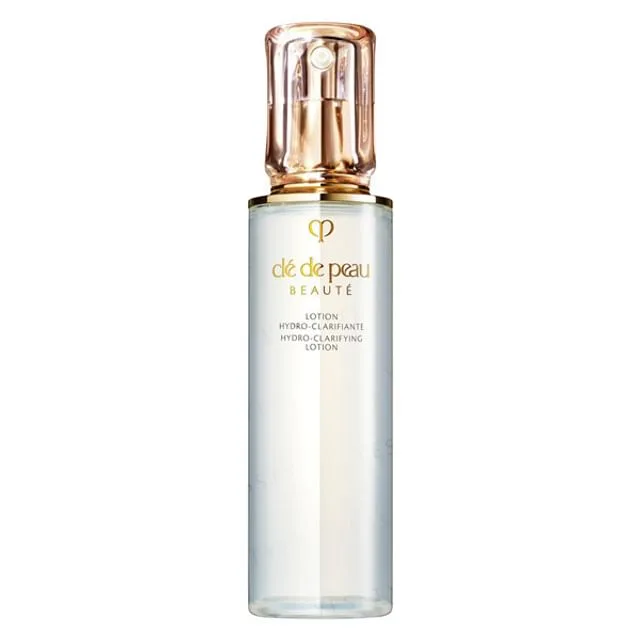
Clé de Peau Beauté
Hydro-Clarifying Lotion
This lightweight lotion absorbs instantly without any sticky residue, making it perfect if you prefer a quick-drying formula that doesn't feel heavy on skin.
43 of 43 ingredients identified
Informational only — check the packaging and a professional for advice.
Actives combined with exfoliation
This formula pairs active ingredients with exfoliation. Introduce gradually and watch for sensitivity.
Contains fragrance
Fragrance is a common trigger for sensitivity and irritation in reactive skin.
Category breakdown
Humectant · 12Soothing · 6Emollient · 6Other · 5Antioxidant · 4Solvent / vehicle · 3Preservative · 3Surfactant · 1Fragrance · 1Exfoliant · 1Active · 1
Relationships
Works well together
L-Theanine + Dipotassium GlycyrrhizateTremella Fuciformis Polysaccharide + GlycerinSodium Hyaluronate + GlycerinRosmarinus Officinalis (Rosemary) Leaf Water + TocopherolHydrolyzed Conchiolin Protein + Sodium Acetylated HyaluronateHydrolyzed Conchiolin Protein + TrehalosePEG-30 Phytosterol + Hydrogenated LecithinTrisodium EDTA + Disodium EDTATrisodium EDTA + Phenoxyethanol
Full ingredient breakdown
3
A gold-standard humectant that draws water into the skin.
4
A short-chain polyethylene glycol used as a humectant and solvent to hydrate skin and improve the feel and spreadability of formulas.
6
A sugar-based humectant that holds water and helps skin resist dehydration stress.
8
A plant-derived sugar alcohol that hydrates skin and supports its moisture barrier.
10
An amino acid found naturally in green tea leaves that calms skin sensitivity and reduces inflammatory responses. Used in d program and other Japanese formulations targeting reactive or allergy-prone skin.
15
A small sugar alcohol that acts as a humectant, drawing water into the skin.
19
A licorice-root-derived salt that calms inflammation and soothes irritated, reactive skin.
22
A high-molecular-weight polysaccharide extracted from Tremella fuciformis (snow mushroom), often marketed as a natural alternative to hyaluronic acid due to its exceptional water-binding capacity and film-forming properties.
24
An AHA most often used in small amounts to adjust pH.
25
An acetylated form of sodium hyaluronate with enhanced surface-binding properties that provides long-lasting, film-forming hydration.
26
The salt form of hyaluronic acid; penetrates more readily.
27
A Japanese angelica root extract that soothes skin and offers antioxidant support.
28
An extract from the root of Paeonia albiflora (white peony / Bai Shao), a traditional East Asian botanical distinct from tree peony, used for its soothing, brightening, and antioxidant effects.
29
A naturally occurring amino acid that functions as a humectant and is a component of the skin's natural moisturizing factor.
30
The simplest amino acid, used as a humectant that supports the skin's natural moisturizing factor.
31
A skullcap root extract rich in baicalin flavonoids with potent antioxidant and soothing action.
32
The aqueous distillate (hydrosol) of rosemary leaves. Contains water-soluble antioxidant phytochemicals including rosmarinic acid. Milder than rosemary essential oil but retains conditioning and antioxidant benefits.
33
A silk-derived protein extract that hydrates and imparts a smooth, conditioned feel.
34
An extract from perilla (shiso) leaves in the mint family, rich in rosmarinic acid and flavonoids, used in K-beauty for antioxidant and soothing benefits.
36
German chamomile flower extract rich in bisabolol and apigenin, used to calm and soothe sensitive or irritated skin.
37
A simple monosaccharide sugar used in cosmetics as a humectant to attract and retain moisture in the skin.
38
An extract from the leaves and stalks of Isodonis japonicus (Japanese isodon / rabdosia), a mint-family plant used in traditional Japanese Kampo medicine. Contains diterpenoids with anti-inflammatory and skin-conditioning properties.
39
A hydrolysate of conchiolin, the structural protein from pearl/nacre (Pinctada spp.). Used in luxury Japanese skincare for its moisturising, conditioning, and film-forming properties.
40
Vitamin E; a lipid-soluble antioxidant that also conditions skin.